


 Aug 15,2026
 By docstrail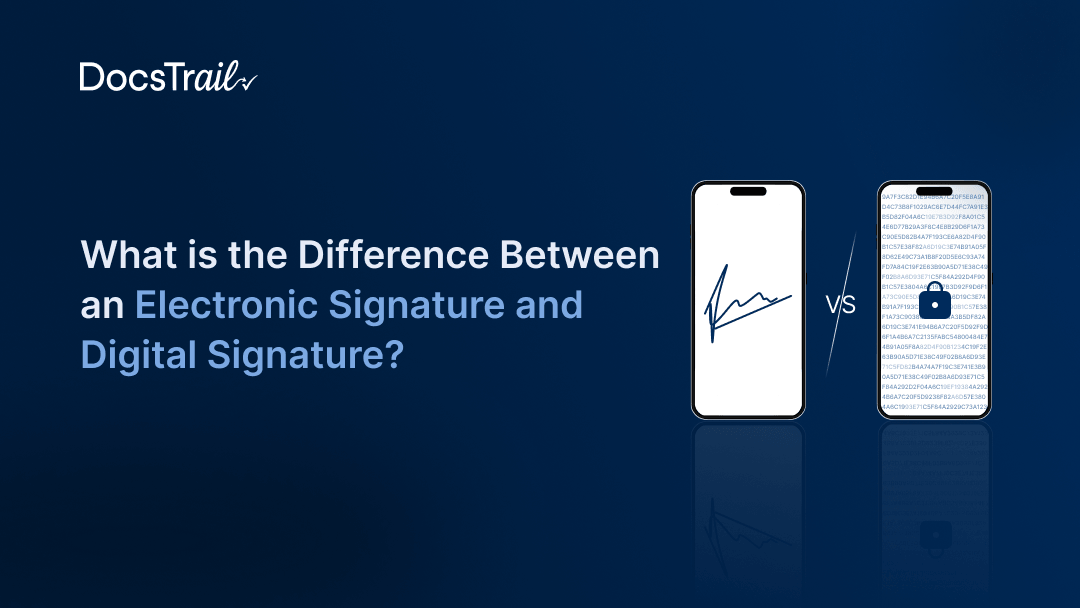
In an era of remote work, automated workflows, and mobile business operations, signing documents on a screen has become a daily routine. From closing a sales deal on a smartphone to approving a multi-million-dollar acquisition, paperless agreements keep modern organisations moving fast. However, as online contracts replace pen and paper, a critical security question arises: Do you know what actually happens behind the scenes when someone signs your document?
Most people use the terms interchangeably, but when comparing an electronic signature vs digital signature, you are looking at two entirely different concepts. One indicates a signer’s intent to agree, while the other provides mathematical proof of identity and document integrity. Using the wrong one for high-value transactions can leave your business vulnerable to fraud, legal challenges, and regulatory non-compliance.
Here is a straightforward guide to understanding how these technologies work, the legal frameworks governing them, and how to choose the right option for secure document signing.
What is an Electronic Signature?
To answer the question, “What is an electronic signature?” It helps to look at how global laws define it. Legally, an electronic signature (eSignature) is any electronic sound, symbol, or process attached to a contract that a person executes with the intent to sign.
At its core, an eSignature focuses on intent. If you take an intentional digital action to signify your agreement to a set of terms, you have created an electronic signature.
Common Examples:
- Typing your name into an online text box.
- Uploading a JPEG image of your handwritten signature onto a PDF.
- Drawing your signature using a touchscreen or stylus.
- Clicking an “I Agree” button on a digital form.
Common Use Cases:
eSignatures are ideal for routine business document signing where speed and convenience are the priority, such as
- Non-disclosure agreements (NDAs)
- Standard employee onboarding forms
- Basic vendor agreements
- Internal sign-offs and approvals
Electronic Signature Security
When evaluating electronic signature security, it is important to know that simple eSignatures rely heavily on basic data like IP addresses, email confirmation links, or timestamp logs to verify who signed. To strengthen your legal standing, reputable software providers record an audit trail electronic signature log. This audit trail records the signer’s IP address, device type, email address, and exact time of signature, giving you a traceable record if a contract is ever disputed in court.
🛡️ Protect Your Contracts with Bank-Grade Security
Stop guessing whether your online signatures are legally binding. Upgrade your workflows with automated cryptographic audit trails, PKI encryption, and seamless eIDAS compliance.
[Start Your 14-Day Free Trial]
What is a Digital Signature?
If you are wondering, “What is a digital signature?” think of it as a specialized, ultra-secure subcategory of electronic signatures. While a simple eSignature acts like a typed mark, a digital signature acts like a tamper-evident, encrypted seal.
Rather than relying on visual marks, a digital signature relies on public key infrastructure (PKI) cryptography. When you sign a document digitally, the software generates a unique mathematical key pair (a private key and a public key) and binds your identity to the file using a digital certificate issued by a trusted Certificate Authority (CA).
[Document Data] —> (Cryptographic Hash) —> [Encrypted with Private Key]
[Digital Signature Created]
(Any change invalidates signature)
Digital Signature Security
The core advantage of digital signature security is that it is tamper-evident.
- When a document is digitally signed, the software creates a unique cryptographic fingerprint (a hash) of the document content.
- If anyone modifies even a single word, space, or number in the PDF after signing, the mathematical hash breaks.
- The recipient’s software instantly displays a warning stating that the document has been altered and the signature is invalid.
Due to its built-in protection, digital signatures deliver the highest standard of secure digital signing available today. They are mandatory for high-stakes agreements like property deeds, cross-border financial transactions, healthcare records, and government filings.
Key Differences: Electronic Signature vs Digital Signature
To make your decision simple, here is a direct comparison of how both options perform across essential criteria:
| Feature/Dimension | Electronic Signature | Digital Signature |
| Privacy Focus | Shows signer’s intent to agree | Verifies identity and ensures document integrity |
| Underlying Technology | Web interfaces, drawn images, IP tracking logs | PKI, asymmetric encryption, and cryptographic hashes |
| Identity Verification | Basic (email links, SMS verification, IP address) | Advanced (backed by Digital Certificates/CAs) |
| Tamper Detection | Moderate (depends on platform audit logs) | High (any documents alteration breaks the signature) |
| Audit Capabilities | Generates an audit trail electronic signature report | Embeds an immutable, cryptographic audit trail in the file |
| Best Used For | Standard contracts, NDAs, internal approvals | High-value, legal, or heavily regulated agreements |
💼 Need Help Securing Your Enterprise Document Workflows?
From multi-million dollar deals to HR onboarding, sending the wrong signature type can expose your business to legal risks. Talk with our document security experts to build a compliant, tamper-proof signature pipeline today.
[Schedule a 15-Minute Strategy Call]
Legal Standards & Compliance Regulations
Understanding electronic signature regulations is vital to ensure your digital agreements hold up in court. Major jurisdictions have specific laws governing compliant electronic signatures:
United States: ESIGN Act & UETA
In the U.S., the ESIGN Act and the Uniform Electronic Transactions Act (UETA) state that electronic signatures cannot be denied legal effect solely because they are in digital form. Simple eSignatures are legally binding for the vast majority of commercial agreements, provided both parties consent to do business electronically.
European Union: The eIDAS Regulation
In Europe, legal standards are governed by the eIDAS framework. An eIDAS digital signature falls into one of three distinct categories:
- Simple Electronic Signature (SES): Basic eSignatures (e.g., typed names, check boxes) for routine agreements.
- Advanced Electronic Signature (AdES): Requires cryptographic digital signature technology that uniquely identifies the signer and detects subsequent changes.
- Qualified Electronic Signature (QES): The highest security standard. A QES requires identity verification through a Qualified Trust Service Provider (or EU Digital Identity Wallet). Under EU law, a QES is the exact legal equivalent of a handwritten signature.
How to Choose the Right Solution for Your Business
When selecting a tool for secure document signing, weigh your need for speed against your requirement for security.
- Assess the Contract Risk: Low-value, high-volume contracts (like employee handbooks or simple NDAs) work best with standard electronic signatures. High-stakes financial, legal, or medical agreements require PKI-backed digital signatures.
- Review Industry Regulations: Check if your industry (e.g., HIPAA in healthcare, FINRA in finance, or eIDAS in Europe) mandates certificate-backed signatures or strict audit trails.
- Prioritize User Experience: Simple eSignatures allow signers to execute documents in seconds on mobile devices without installing digital certificates.
- Utilise Modern Hybrid Platforms: Today’s top enterprise eSignature tools offer a blend of both approaches. They provide a simple click-to-sign interface while creating a tamper-evident digital signature and audit trail.
Also Read: How Top Sales Teams Get Contracts Signed Faster
Conclusion
When comparing an electronic signature vs digital signature, remember this simple rule:
- An electronic signature shows who intended to agree.
- A digital signature provides cryptographic proof of identity and document integrity.
By understanding these differences, you can implement compliant electronic signatures, protect your company against data tampering, and ensure your agreements remain fully enforceable.
Take a moment to review your company’s document workflows today—are your high-value contracts backed by the security standard they require?