


 Jul 28,2026
 By docstrail
You’ve spent three months building a relationship, diagnosing pain points, running flawless demos, and aligning stakeholders. The prospect has verbally agreed to the pricing, and your internal champion is excited. The deal is, for all intents and purposes, “won.”
Then, you send the contract.
Suddenly, a deal that was moving at lightspeed hits a brick wall. Emails go unanswered. The champion mentions their legal department is “backlogged.” Weeks slip by, the quarter ends, and what should have been a celebrated victory turns into an agonizing waiting game—or worse, a dead lead as a competitor sneaks back in.
This is the “Last Mile” Paradox of B2B sales: organizations spend millions of dollars optimizing their top-of-funnel marketing and mid-funnel sales qualification, only to let their deals die at the goal line due to administrative friction.
Top-performing sales organizations do not treat the contract phase as an administrative formality. Instead, they treat Time-to-Sign (TTS) as a critical competitive metric. By operationalizing their closing sequences, automating document generation, and pre-negotiating legal boundaries, elite revenue teams eliminate the friction that stalls deals.
If you want to maintain momentum, you need to learn how to get contracts signed faster by deploying modern, robust digital contract management strategies.
The Real Cost of Contract Friction
Every day a contract sits unexecuted, your deal is in jeopardy. Deal fatigue is a very real psychological phenomenon. The initial excitement of the purchase decision naturally decays over time. As days turn into weeks, internal priorities at your buyer’s company can shift, budgets can be frozen, or a new executive can step in and demand a review of all pending vendor agreements.
To close deals faster, modern enterprises must address the administrative weight placed on the prospect. The longer your contract turnaround time, the more opportunities your buyer has to second-guess their decision, search for alternative vendors, or completely abandon the project due to shifting internal priorities.
- The Cost of Delay: Industry data shows that deal closure probability drops by up to 15% for every week a contract remains stuck in legal or administrative limbo.
Moreover, slow contract cycles balloon your Customer Acquisition Cost (CAC) by tying up your Account Executives (AEs). Instead of prospecting and closing new business, your highly paid sales reps are reduced to administrative wranglers, sending desperate follow-up emails and trying to decode redlines. By empowering your force with the right eSignature for sales teams, you reclaim valuable selling hours and boost overall organizational velocity.
To fix this, we must first look at where the traditional closing system breaks down.
⚡ Stop Chasing Signatures. Close Deals Faster.
Our digital contract management platform helps top sales teams reduce time-to-sign by up to 70%. Generate, negotiate, and execute secure agreements in minutes.
Anatomy of the Modern Contract Bottleneck
Traditional sales organizations suffer from four distinct bottlenecks in their closing pipeline. Without comprehensive sales contract automation, reps spend their days manually pushing paper rather than driving revenue.
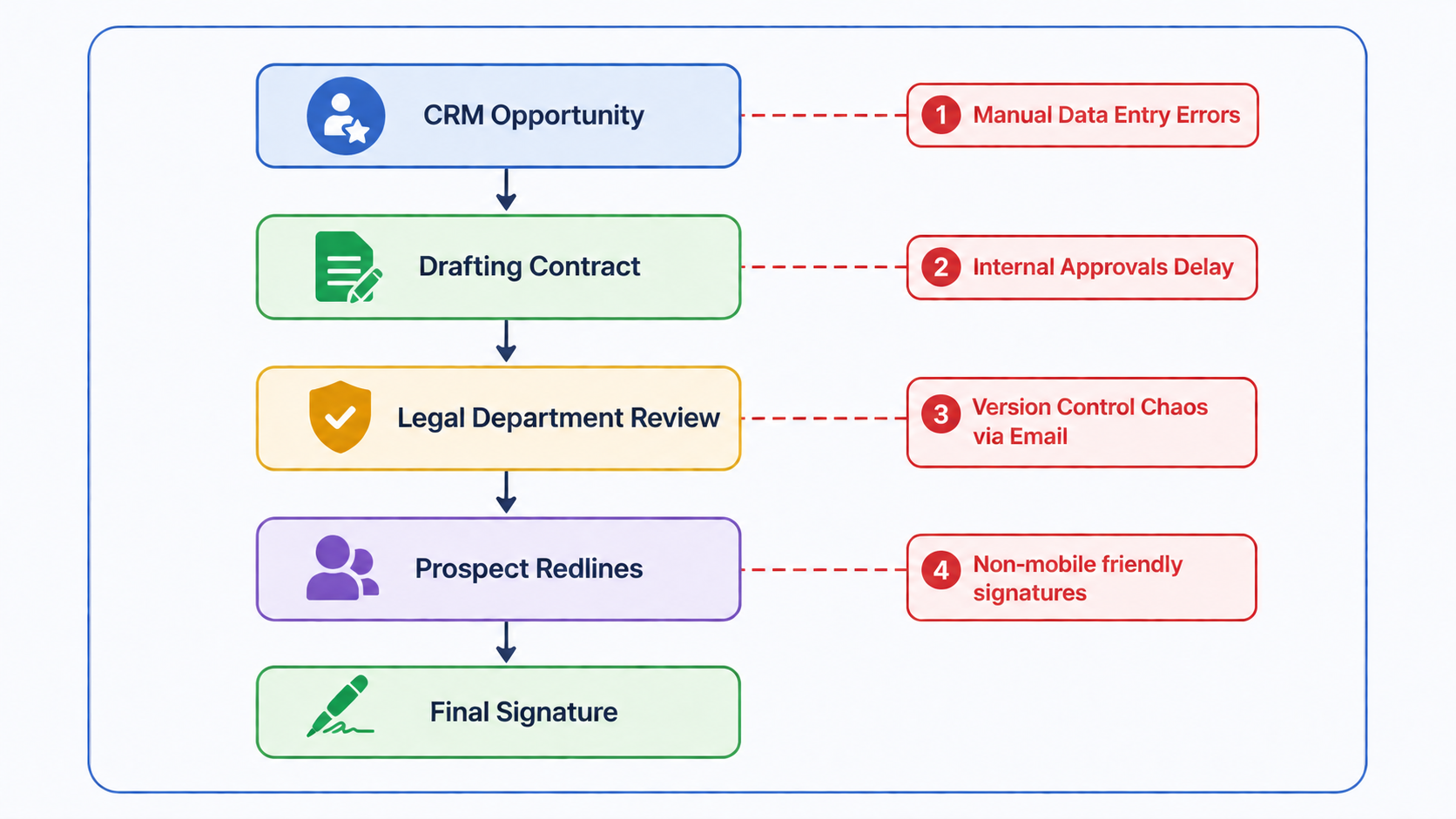
- Generation Friction: A sales rep manually copies and pastes customer details from a CRM into an outdated Word template, introducing typos, incorrect pricing structures, or outdated legal terms.
- Internal Approval Latency: The contract sits in a corporate legal inbox for 72 hours because a rep modified a non-standard clause without prior authorization. To speed up contract approvals, these workflows must be standardized.
- The Redline Black Hole: The prospect’s legal team receives the document and marks it up heavily, initiating a disjointed, asynchronous email chain across multiple time zones.
- Signing Execution Friction: The final signer lacks a mobile-friendly, secure online contract signing tool, delaying execution until they are back at their desktop computer.
Top sales organizations systematically eliminate these four stages of friction using a structured, five-pillar approach built around modern sales productivity tools and workflows.
Pillar 1: Dynamic Sales Contract Automation
Elite sales teams treat contracts as programmatic logic models rather than static Word documents. This shift in mindset requires transitioning to a fully digitized workflow that leverages automated rules.
- CRM-Driven Document Generation
When a deal reaches the “Contract Sent” stage, the contract should practically write itself. By integrating your CRM platform (such as Salesforce or HubSpot) directly with a digital contract management platform, all metadata—such as company name, billing address, SKU volumes, discount tiers, and implementation dates—maps directly to the document fields.
This completely eliminates manual copy-pasting, ensuring that what was agreed upon in the sales pipeline matches the contract exactly.
- Standardized Conditional Clauses
Instead of relying on legal to draft bespoke language for non-standard deals, top teams build conditional logic libraries directly into their document templates. This is a core component of sales contract automation.
- Example: If a sales rep inputs “Net-60” payment terms in the CRM instead of the standard “Net-30”, the document generator automatically swaps out the payment terms clause with pre-approved Net-60 legal verbiage and routes it to the finance director for automated approval.
By taking these small decisions out of human hands, you naturally shorten your contract turnaround time and protect your margins from unapproved discounts or concessions.
🚀 Scale Your Close Rate Like the Top 1%
See how leading sales organizations use our workflow automation to slash contract turnaround time from weeks to hours and reclaim 25% more selling time for AEs.
Pillar 2: The Pre-Negotiated Legal Framework
The single biggest source of delay in B2B transactions is the legal showdown. High-velocity sales teams mitigate this by proactively setting boundaries for their sales reps and their buyers to speed up contract approvals before negotiations even begin.
- The Tiered Playbook for Redlines
Top revenue teams partner with their General Counsel to establish a clear, tiered sales concession playbook. This document outlines exactly what concessions a sales representative is allowed to make on their own, what requires regional director approval, and what must go to legal.
| Concession Tier | Contract Issue | Allowable Sales Action |
| Tier 1: Green | Governing Law/State Jurisdiction | Rep can change state to match the client’s home state without approval |
| Tier 2: Yellow | Payment Terms (Net-30 to Net-45) | Rep can accept if total contract value exceeds $50k |
| Tier 3: Red | Indemnification/Liability caps | Absolute stop. Requires General Counsel approval |
By empowering AEs with a pre-approved negotiation matrix, you eliminate the back-and-forth emails between sales and legal for minor changes, shaving days off the negotiation cycle.
- The Power of Modular Agreements
Traditional contracts force a buyer’s legal team to review 30 pages of standard legal terms alongside transaction-specific details. Top teams shorten this process by separating the Master Services Agreement (MSA) from the Statement of Work (SOW).
Your standard MSA can be hosted publicly on a secure, version-controlled web page. The document sent to the buyer is a streamlined, highly focused SOW that simply references the online terms.
Instead of reviewing a massive document, the client’s legal team only has to review a 2-page SOW detailing the scope, deliverables, and commercial terms. This dramatically shrinks the review cycle and helps you close deals faster.
Pillar 3: Collaborative Real-Time Workflows
Sending a contract as an email attachment is an open invitation for a deal to stall out. When contracts are sent as ‘.docx’ attachments, version control breaks down immediately. You end up with file names like ‘Contract_v2_Final_EDITED_Internal_ClientComments_v3.docx’. No one knows which draft is current, and mistakes are easily made.
To truly streamline your pipeline, you must implement a modern sales workflow automation strategy that brings legal negotiations into the cloud.
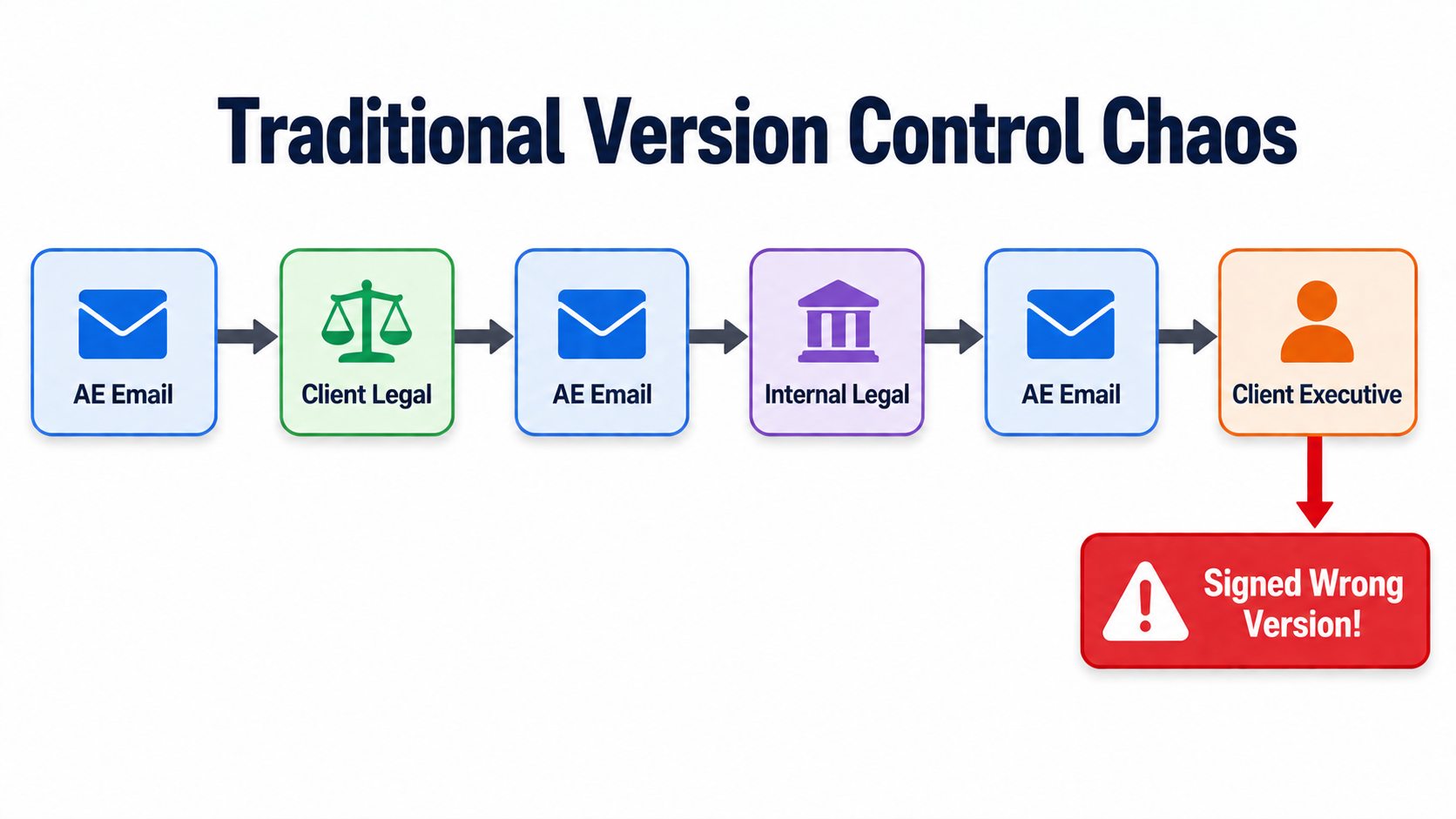
Collaborative Cloud Negotiation
High-performing teams use interactive, web-based contract platforms that function as dedicated contract signing software. Instead of exchanging attachments, both parties work inside a single, secure cloud-based document.
All redlining, commenting, and editing occur in real time, with an audit trail showing exactly who made which change. This collaborative environment keeps both parties focused on the same page—literally—and speeds up negotiations.
Multi-Recipient Sequential Routing
A contract often requires approvals from multiple people within the buyer’s organization. If a sales rep has to manually forward the signed document from one department to another, the deal loses momentum.
Top sales groups use automated routing workflows. Once the technical buyer signs off, the document automatically routes to the finance team, and finally to the executive sponsor. The system keeps the document moving forward without requiring manual intervention from the sales rep, significantly dropping your total contract turnaround time.
⏳ Cut Your Time-to-Sign Today
Drop our eSignature tools directly into HubSpot or Salesforce and send your first 3 contracts completely free. No setup friction, no credit card required.
Pillar 4: Frictionless Mobile Execution and Security
The final click should be the easiest part of the journey. Yet, many sales teams still send agreements that are difficult to open, review, or sign on a mobile device. This is where deploying a dedicated electronic signature for sales becomes a massive competitive differentiator.
Mobile-First Sign-Off
C-level executives and decision-makers are rarely sitting at their desks waiting to sign vendor agreements. They are often in transit, in meetings, or managing their work from a smartphone.
If your contract requires them to download a PDF, open a clunky portal, or find a desktop to execute a signature, the document will sit.
Top sales teams use responsive, mobile-first eSignature for sales teams. A busy executive should be able to open the contract from a secure link in an SMS message or email and sign it with two taps on their screen. Reducing the physical effort required to sign directly correlates with a lower overall sales cycle length. Utilizing smooth online contract signing is no longer a luxury; it is a baseline requirement to keep enterprise deals moving.
Fully Auditable, Secure Document Signing
Enterprise security teams can delay signatures if they feel a signing process is unsecure. Using robust, fully compliant secure document signing tools that meet SOC 2, HIPAA, and GDPR standards gives enterprise buyers the confidence they need to sign immediately.
When your legal team can guarantee a fully auditable trail, you eliminate security questionnaires that stall out your deals at the very last moment.
Pillar 5: Behavioral Economics and Nudge Strategies
Accelerating contract execution is as much a psychological challenge as it is an operational one. Top-performing sales professionals use subtle behavioral cues to keep the signing process moving forward, backed by automated systems.
Automated System Reminders
When a sales rep manually emails a prospect to ask, “Just checking in on the status of this contract,” it can sound transactional and desperate.
Instead, top teams let sales workflow automation handle the follow-ups. System-generated reminders sent at optimized times (e.g., Tuesday mornings at 10:00 AM) frame the follow-up as an objective, system-driven process rather than salesperson pressure.
A notification from your contract signing software that reads, “Your document link expires in 48 hours,” prompts action far more effectively than a manual email from an AE.
Linking the Signature to Client Value
Rather than framing the contract deadline around your sales quota or quarter-end, tie the signing date directly to the prospect’s goals.
Align the contract execution timeline with their desired kickoff date:
- “To secure our October 1st onboarding slot and ensure your team is trained before the holiday rush, we just need to finalize the paperwork by Friday. If we sign after that, our implementation queue pushes the kickoff to late November.”
By reframing the signature as the key to unlocking their success, you transform a tedious administrative step into a critical milestone they want to reach quickly. This simple psychological shift is one of the most powerful sales productivity tools in your arsenal.
Summary & Implementation Checklist
To close deals faster, you must optimize your final stage. Contract velocity is a massive competitive advantage. Companies that make it incredibly easy for clients to buy will consistently win deals over competitors with slow, rigid, and manual legal processes.
By automating document generation, establishing clear negotiation playbooks, utilizing real-time collaboration tools, and choosing mobile-first, secure document signing solutions, you can turn your contract phase from a bottleneck into an efficient closing engine.