


 Jun 04,2026
 By docstrail
Paper contracts are a thing of the past. Deals now close in seconds, across countries, all in the cloud. But this speed brings a problem: not all e-signatures carry the same legal weight.
At first, signing digitally seems easy. Many businesses think dragging a photo of their signature onto a PDF is enough. But that can be risky. If a big contract ends up in court, a basic signature might not hold up.
That’s where the Qualified Electronic Signature (QES) comes in. It’s the strongest type of e-signature you can use. It offers the highest level of security, identity checks, and legal power of any digital signing method.
As digital laws like eIDAS keep growing stricter, more businesses need to understand this signature type. Let’s break down what a QES is, how it works, and when your business actually needs one.
What Is a Qualified Electronic Signature?
To understand a QES, you need to know how digital signatures are ranked. Europe’s eIDAS law sets the global standard here. It splits e-signatures into three levels — like a security pyramid.
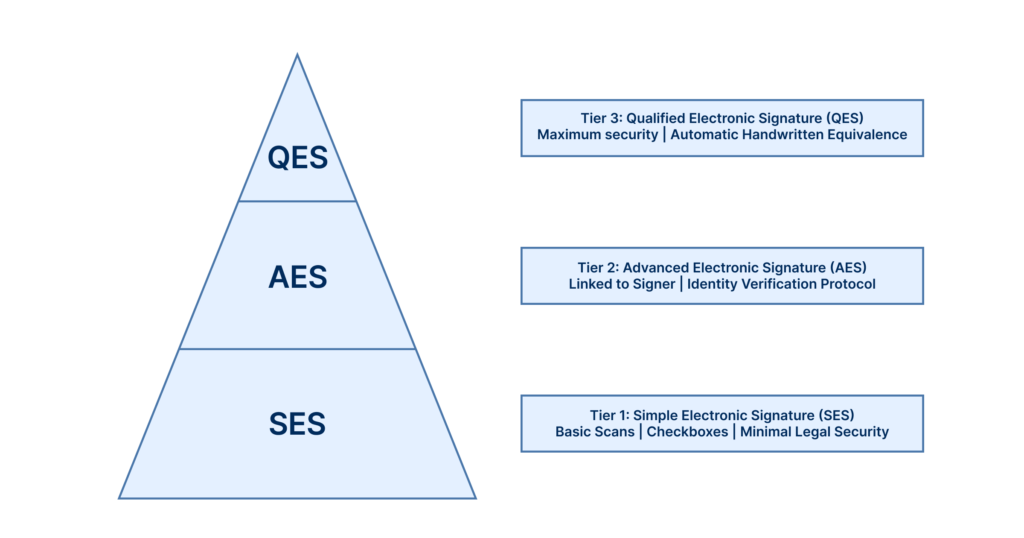
1. Simple Electronic Signature (SES)
This is the most basic level. It’s easy to use. But it proves nothing about who signed it. If someone challenges it in court, you have to prove who was really behind the screen.
2. Advanced Electronic Signature (AES)
This is a big step up. An AES must be tied to one specific person. It must be made using something only they control, like a code sent to their phone. And if the document changes later, the system must catch it right away.
3. Qualified Electronic Signature (QES)
This is the strongest option. It meets every rule of an AES, plus two more strict checks set by the government:
- It must be backed by a special ID certificate from an approved company, called a Qualified Trust Service Provider (QTSP).
- It must be created using a secure, tamper-proof device made just for this purpose.
Why this matters: A QES is the only type of e-signature that carries the same legal power as a signature written by hand. This is true across the EU and in many other countries too.
Is your business protected in court? A basic digital mark won’t hold up under pressure. Switch to a qualified signature and put the burden of proof on the other side. Talk to an expert to check your current signing process for gaps.
What Does a QES Actually Require?
You can’t make a true QES with basic software or a simple email check. The rules are strict on purpose. This keeps things fully secure.
Here’s what’s required:
Strong ID Checks Before anyone can use a qualified electronic signature , a trusted authority must confirm who they are. In the past, this meant showing your passport in person. Now, it often happens by video. AI scans your face and your ID in real time to prove you are who you say you are.
A Trusted Provider The signature must run through an approved company called a Trust Service Provider. These firms are watched closely and checked often. You can find them on official government lists.
Secure Hardware The signing keys live on a special, locked device. In the past, this meant a smart card or a USB key. Today, it’s often a secure cloud system. You unlock it with a fingerprint or a code.
Full Document Protection Once you apply a QES, the whole file gets sealed shut. If even one letter changes after signing, the seal breaks. Everyone can tell right away.
When Do You Really Need a QES?
A basic or advanced signature is fine for daily tasks. Think internal approvals, simple purchase orders, or standard vendor deals. But in some cases, only a QES will do. A weaker signature could make your contract fall apart.
1. Big Financial Deals and Banking Banks run on trust. They must also follow strict fraud rules. For loans, credit deals, or opening big business accounts, a QES signature gives a clear, trusted record. It matches strict “know your customer” rules too.
2. Healthcare and Pharma In fields where safety comes first, a QES proves that data wasn’t changed or backdated. This matters for clinical trial records and drug supply sign-offs.
3. HR and Job Contracts In many countries, the law says that job contracts, non-compete deals, and termination notices must be signed by hand — or with a QES, the only digital option that counts the same way. This shields your business from legal disputes later.
4. Real Estate and Property Leases Buying property or signing a long lease means big money is on the line. A QES counts as a handwritten signature by law. So these deals can now happen fully online. No in-person notary needed.
5. Government Contracts When bidding on lucrative public sector contracts or submitting official corporate tax documents, state agencies generally mandate an eIDAS-qualified electronic signature. This ensures all competing entities are authenticated, eliminating the risk of fraud in public procurement.
What’s New in Digital Signing?
Digital ID tools are changing fast. We’re moving away from clunky USB keys, slow downloads, and long waits for video ID checks.
A new law called eIDAS 2.0 is changing the game. Every EU country is rolling out a Digital Identity Wallet — a secure app on your phone.
This wallet holds your ID, license, and other records in one place. To sign something, you just use your face or your fingerprint. There’s nothing to download. No hidden fees. No wasted time. This makes strong, secure signing easy for everyone.
Meet the future of easy signing. No clunky tokens. No long waits. Just fast, secure signing your team and clients will love.
Why QES Is Good for Business
A QES is not just a legal box to check. It also helps your business run better.
- The other side must prove it’s fake. With a basic signature, you must prove it’s real if someone fights it. With a QES, the law assumes it’s valid from the start. That’s a big win for your legal team.
- Deals close faster. Big deals often stall at the signing stage. A qualified electronic signature cuts that wait. Buyers can sign from their phone in minutes.
- You save money. Printing, mailing, and storage all cost time and cash. Going fully digital cuts these costs. Your files stay easy to find too.
- Your data stays safe. Strong encryption guards your deals and data from theft, fraud, and tampering.
Also Read: Choosing Between Simple, Advanced, and Qualified eSignatures
Which Signature Should You Use?
Not every document needs a QES. Match your signature type to how much risk is at stake.
| Document Type | Risk Level | Best Signature | Why |
|---|---|---|---|
| Internal approvals, leave requests, meeting notes | Low | Simple (SES) | Fast and easy. No outside legal risk. |
| B2B sales contracts, standard NDAs, vendor deals | Medium | Advanced (AES) | Strong tracking and logs, without full ID checks. |
| Cross-border deals, mergers, big loans, job contracts | High | Qualified (QES) | Top security. Equal to a handwritten signature. |
Final Thoughts
Using a weak signature for a big deal is a real risk. Rules keep getting stricter around the world. Today’s businesses need fast, secure signing that holds up under pressure.
A qualified e-signature platform shields your business from legal risk. It also keeps you fast, flexible, and ready to grow. Don’t let a weak signature put your next big deal at risk. Upgrade your signing process now, and sign with full confidence.