



 Jun 11,2026
 By docstrail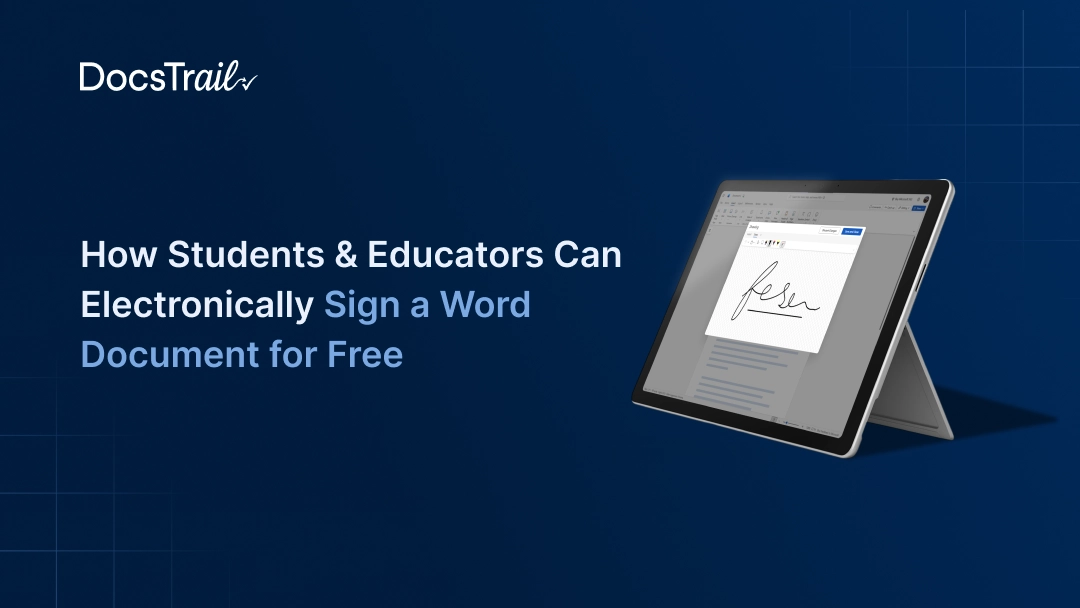
Education runs on paperwork. Enrollment forms, permission slips, financial aid agreements, scholarship applications, faculty contracts, research consent forms, student accommodation requests, and policy acknowledgements all require signatures. Most people outside education underestimate just how many documents schools and universities process every year.
For years, the process stayed the same: print, sign, scan, email, or submit paperwork in person. It was slow, paper-heavy, and inefficient. These manual workflows created delays, frustrated students, increased administrative workloads, and slowed decisions that needed to move faster.
In 2026, there is little reason to continue relying on outdated signing processes. Students and educators can now electronically sign a Word document for free using any device with internet access. Modern e-signature tools make document signing faster, more professional, and legally recognized in many situations.
This guide explains how to electronically sign a Word document, which methods work best for educational use, and how to create a workflow that saves time without adding unnecessary complexity.
Why Electronic Signatures Matter in Education
The education sector handles a high volume of documents that require signatures. Schools and universities regularly collect approvals for student activities and administrative processes. These include field trips, clubs, athletics, media releases, health forms, and many other education-related services.
The scale of this paperwork is larger than many people realize. A single university admissions cycle can generate thousands of signed enrollment forms, financial aid agreements, housing contracts, and consent documents. K–12 schools also process large volumes of permission forms each year. Faculty recruitment adds another layer through employment contracts, compliance acknowledgements, and benefits enrollment documents.
Traditionally, every one of these documents required a handwritten signature. That process involved printing, collecting signatures, filing paperwork, and later scanning or storing physical copies. The result was slower processing times and more administrative work.
Electronic signatures simplify this entire workflow. Signed documents can be securely stored and archived for long periods without the risk of paper being damaged, misplaced, or lost. For institutions managing thousands of records each year, this improves both efficiency and document retrieval.
Electronic signatures also provide strong security protections. Paper documents can be forged or physically altered. Modern e-signature platforms use security measures such as encryption, digital certificates, and audit trails to help maintain document integrity and reduce the risk of tampering.
For students, the benefit is straightforward. You can electronically sign a Word document from anywhere without printing forms or visiting an office during limited operating hours.
Method 1: Using Microsoft Word’s Built-In Signature Line
The most direct way to electronically sign a Word document without any third-party tool is to use the signature functionality built into Microsoft Word itself. This method is available to anyone with Microsoft 365 or a desktop version of Word.
Step 1 — Insert a signature line
Open your Word document and place your cursor at the position in the document where the signature should appear. Go to the Insert tab in the ribbon and click Signature Line in the Text group. A dialog box will appear asking for the signer’s name, title, email address, and any instructions for the signer. Fill in the relevant details and click OK.
A signature line placeholder will appear in the document with an X mark and the signer’s name below it.
Step 2 — Sign the signature line
To sign, double-click the signature line. A dialog box will open. Choose one of the available options:
- Draw your signature using a stylus or touchscreen if your device supports it.
- Type your name. Word will display it in a signature-style font.
- Upload an image of your handwritten signature.
Step 3 — Confirm and save
Click Sign to finish the process. Word marks the document as signed and may label it as Final. This helps prevent additional edits. If changes are needed later, the signature may need to be removed first.
When this method works well
This method works best for individual documents shared between people using Microsoft Word. It is useful when a detailed audit trail is not required.
Good examples include:
- Academic submissions
- Internal faculty documents
- Simple administrative forms
For these use cases, Word provides a fast and convenient signing experience.
What to know
Word’s built-in signature line does not create the same level of tracking as a dedicated eSignature platform.
It records the signing event within the document certificate. However, it does not typically provide features such as IP tracking, shareable timestamps, or independent signature verification outside the Word file.
For internal education documents and low-risk use cases, this approach is often sufficient. For documents with legal or compliance requirements, a dedicated eSignature platform is usually a better option.
Method 2: Convert to PDF and Sign with DocsTrail (Free, Legally Compliant)
For educational documents that require stronger verification, electronic signatures offer a reliable and free solution. This includes scholarship agreements, enrollment contracts, faculty employment offers, research consent forms, and student accommodation agreements. Using the right signing method helps create a more secure and professional signing experience.
The process has two parts: converting the Word document to PDF, and then signing through DocsTrail’s free platform.
Step 1 Export from Word as PDF
In Microsoft Word, go to File → Save As → PDF, or File → Export → Create PDF/XPS. This saves a PDF version of your document to your device. If you are using Google Docs to work on the document, go to File → Download → PDF Document (.pdf).
PDF is the preferred format for signed documents because it is not natively editable — which means the content of the agreement is fixed the moment you export it, and any attempt to alter it after signing will be detectable.
Step 2 Upload to DocsTrail
Open Docstrail Free Online Document Signing in any browser. No account creation is required to get started. Upload your PDF — the platform also accepts Word files directly if you prefer to skip the conversion step.
Step 3 — Create your signature
DocsTrail gives you three options: type your name in a professional handwriting-style font, draw your signature using your mouse, trackpad, or touchscreen, or upload an image of your actual handwritten signature. Students signing enrollment documents or educators countersigning faculty agreements can use whichever method produces the most appropriate result for the formality of the document.
Step 4 — Place the signature and finalize
Drag your signature to the correct position on the document. Add date fields or initials if required. Finalize the document.
Step 5 — Download or send for countersignature
Download the signed PDF immediately, or if another party needs to sign — a parent, an institutional administrator, a faculty supervisor — enter their email address, assign their signature fields, and send. They receive a secure link, sign from any device, and you receive the completed document with full audit trail.
Every document signed through DocsTrail is backed by a complete, legally compliant audit trail — timestamps, signer identity, IP address, and a tamper-evident cryptographic seal. This is what makes the signature genuinely legally binding rather than just a mark on a page.
Method 3: Using Word’s Draw Tool for Quick Informal Signatures
For students who need to electronically sign a Word document quickly without converting to PDF first — a coursework declaration, a peer collaboration agreement, or an informal academic form — Microsoft Word’s Draw feature offers a fast solution.
Go to the Draw tab in the Word ribbon. If it is not visible, right-click the ribbon and select Customize the Ribbon, then enable the Draw tab. Select a pen tool and use your mouse, trackpad, or touchscreen to draw your signature directly in the document at the appropriate position.
This method works best on touchscreen devices — Windows tablets, Surface devices, iPad with a keyboard, or any device with stylus support. On a standard laptop trackpad, drawing a clean signature takes practice. A useful tip: sign slowly, use a fine-tip pen setting, and use landscape orientation if drawing on a touchscreen to give yourself more space.
When to use this method: Informal academic documents, internal class forms, draft agreements between peers, and any low-stakes document where the primary requirement is simply having a name on the page.
When to step up to a proper platform: Any document involving financial commitments, legal agreements, institutional compliance, or external parties should be signed through a platform with proper audit trail infrastructure rather than a drawn image in a Word file.
Method 4: The Mobile Workflow for Students on the Go
Students in 2026 complete much of their academic work on phones and tablets, not just laptops. As a result, the ability to electronically sign a Word document from a mobile device has become a practical need.
DocsTrail works directly in mobile browsers on both iPhone and Android. No dedicated app is required. The process is simple. Upload the document, create or select a signature, place it in the correct location, and then download or send the completed file.
The interface is designed for touchscreen devices. This makes signing from a phone faster and more comfortable than manually zooming and adjusting a document.
For students receiving documents by email, the mobile workflow is especially convenient. Common examples include scholarship letters, housing agreements, and internship contracts.
Open the email, download the attachment, upload it to DocsTrail in Safari or Chrome, sign the document, and send it back. The entire process can take only a few minutes and can be completed from anywhere with an internet connection.
Specific Use Cases: How Students and Educators Use Electronic Signing
Understanding the practical applications of the ability to electronically sign a Word document helps both students and educators see where digital signing fits into their daily academic life.
Enrollment and admissions forms
The platform provides a seamless and efficient way for educational institutions to manage their enrollment and admissions processes. Students can easily complete and sign forms electronically, reducing the need for physical paperwork and streamlining the process. For incoming students managing the administrative load of starting a new term or academic year, digital signing removes a category of physical logistics entirely.
Permission and consent forms
Schools and universities regularly need signed approval for student activities and services, from field trips and clubs to athletics, media releases, and health-related acknowledgments. Electronic signing allows these to be distributed, signed, and returned in a day rather than over several weeks of paper-chasing.
Financial aid and scholarship agreements
These documents carry significant financial and legal weight. Using a platform with proper audit trail documentation ensures that agreements are properly verified and that both the institution and the student have a defensible record of what was agreed and when.
Research participation consent forms
Academic research involving human participants requires informed consent documentation that meets ethical and legal standards. Electronic signing platforms that generate complete audit trails produce consent records that are suitable for institutional review board documentation.
Faculty employment agreements and HR documents
Educators manage many of the same document-signing requirements as other professionals. These documents often include employment contracts, benefits enrollment forms, institutional policy acknowledgements, sabbatical agreements, and research contracts. Using electronic signatures makes this process faster and more efficient. Faculty members can sign Word documents remotely without printing paperwork or visiting an HR office. This helps simplify onboarding and reduces administrative delays.
Student accommodation contracts
University housing agreements are binding contracts with real financial and legal implications. Electronic signing through a compliant platform creates a documented record of the agreement that protects both the institution and the student.
Parental consent for minors
For K-12 schools managing permissions from parents, electronic signing dramatically reduces the administrative overhead of printed consent forms. Parents can sign from their phone in response to an email notification, and the school has a verified digital record of the consent.
What Makes Electronic Signatures Legally Valid for Educational Documents
Many students and administrators ask the same question: do electronically signed documents carry the same legal value as paper documents? In most educational situations, the answer is yes.
In the United States, electronic signatures became legally recognized through the ESIGN Act and UETA. Under these laws, electronic signatures generally have the same legal effect as handwritten signatures for contracts, agreements, and formal acknowledgements. This covers most documents used by schools and universities.
When choosing a free document signing tool, three factors matter most: legal compliance, ease of use, and security.
DocsTrail is designed around these requirements. Its signatures support ESIGN and eIDAS standards. The platform is easy to use and does not require technical expertise. Documents are also protected through encryption and a tamper-evident audit trail.
There are limited exceptions. Certain wills, court documents, and notarized records may follow different rules in some jurisdictions. However, for most educational paperwork, including enrollment forms and faculty agreements, electronic signatures are generally accepted.
Choosing the Right Free Tool for Your Educational Context
Not every tool is equally appropriate for every type of educational document. Here is a practical guide:
For informal student documents, coursework declarations, and low-stakes forms
Microsoft Word’s built-in signature line or draw tool handles these quickly without needing any additional platform.
For legally binding agreements with financial or institutional consequences
Use DocsTrail’s free signing platform. The audit trail it generates creates a proper legal record that both parties can reference if questions arise later.
For sending documents to parents, students, or external parties for remote signature
DocsTrail’s outbound signing workflow handles this completely. Upload the document, assign signature fields to each recipient, and send. They sign from any device without creating an account.
For high-volume institutional workflows
For schools and universities processing hundreds or thousands of signed documents per semester, DocsTrail’s platform scales to team and institutional use with organized document management, shared templates, and real-time tracking across all sent documents.
Also Read: How Real Estate Agents Electronically Sign a Word Document in 2026
Getting Started
Electronic signing has become easier than ever for the education sector. Students can electronically sign a Word document for free in just a few minutes using a browser and the device they already own.
Educators can also save time by creating reusable signing templates. A template can be set up once and used throughout the semester without repeating the process.
Paper-based workflows often create unnecessary delays. Forms sit in bags, arrive late, or get misplaced between offices. Digital signing removes many of these common document challenges and improves record management.
Students and educators work more efficiently when documents move as quickly as modern academic life. Electronic signing supports that speed. With free tools such as DocsTrail available online, making the switch no longer requires waiting for the next semester.
Ready to sign your first document? Upload a Word document or PDF and sign for free with DocsTrail — no account required.