


 Mar 13,2026
 By docstrail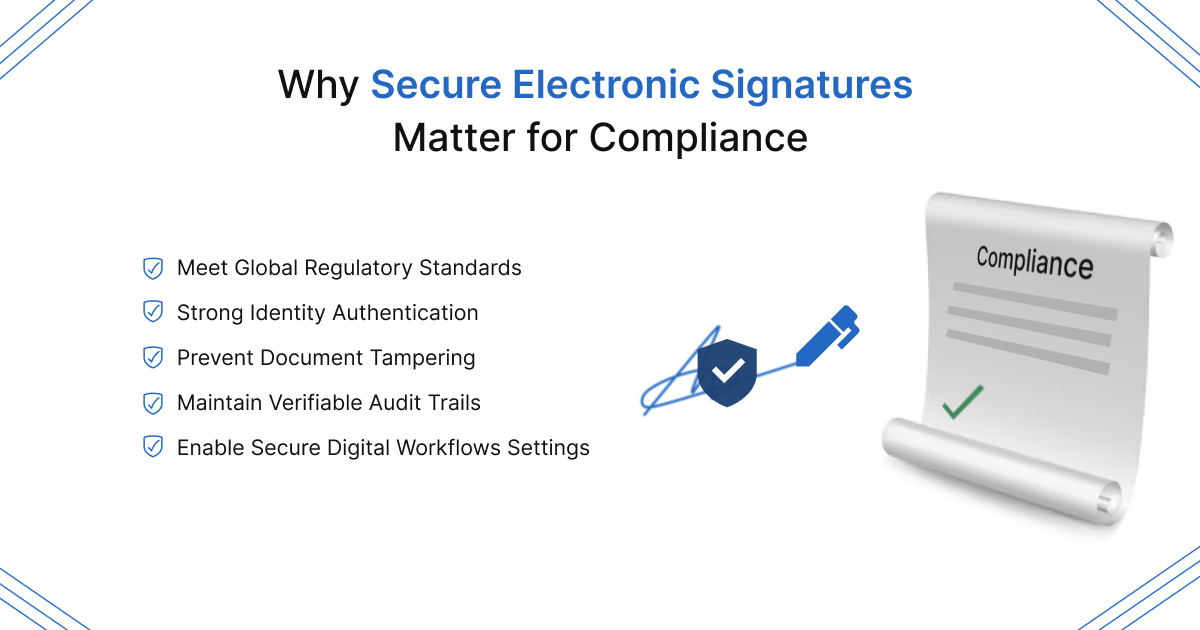
In the high-speed digital economy of 2026, the traditional “wet ink” signature has become a relic of the past. From multinational merger agreements to remote employee onboarding, business now moves at the click of a button. However, as the volume of digital transactions grows, so does the risk. For many organizations, the difference between a legally binding agreement and a costly legal dispute hinges on one factor: secure electronic signatures.
While most people equate an “e-signature” with a simple typed name or a scanned image of a handwritten signature, these methods often fail to meet modern eSignature compliance standards. In a world of sophisticated deepfakes and cyber-fraud, “simple” is no longer enough. To ensure your documents are defensible in court and compliant with global regulators, you must understand the technical and legal pillars that make an electronic signature truly secure.
Defining the “Secure” in Electronic Signatures
The term “electronic signature” is often used as a broad umbrella, but in the eyes of the law, not all signatures are created equal. To achieve true electronic signature security, a signature must do more than just represent a person’s name; it must prove their identity and the integrity of the document.
The Hierarchy of Signatures: SES, AES, and QES
To understand digital signature compliance standards, we must look at the three-tier system used by most international frameworks, such as the EU’s eIDAS 2.0.
- Simple Electronic Signatures (SES): These are the most basic. A typed name at the bottom of an email or a checkbox on a website falls into this category. While they indicate intent, they offer no proof of identity and are easily tampered with.
- Advanced Electronic Signatures (AES): An AES must be uniquely linked to the signer and capable of identifying them. It is created using data that the signer can use under their sole control. Most importantly, it is linked to the document in a way that any subsequent change is detectable.
- Qualified Electronic Signatures (QES): The gold standard of legally binding electronic signatures. A QES is an AES created by a qualified signature creation device and based on a qualified certificate issued by a trust service provider (TSP). In many jurisdictions, a QES is the only type that is automatically granted the same legal status as a handwritten signature.
The Role of Public Key Infrastructure (PKI)
At the heart of secure electronic signatures is PKI technology. This involves a pair of keys—a private key kept by the signer and a public key used by others to verify the signature. This cryptographic “binding” ensures that the signature is inextricably linked to the specific version of the document being signed. If even a single character is changed after the signature is applied, the “digital seal” breaks, alerting all parties to potential tampering.
Quick Compliance Audit
Are you still using scanned images or basic PDFs for signatures? You might be at risk of non-repudiation. Our compliant eSignature software provides the audit trails and electronic signature security required by global regulators.
[Get a Free Security Consultation]
The Global Legal Landscape: Why eSignatures are Legally Valid
A common question from stakeholders is, “Why are eSignatures legally valid?” The answer lies in the robust legal frameworks established over the last two decades, which have matured significantly as of 2026.
The United States: ESIGN and UETA
In the U.S., the federal ESIGN Act (2000) and the state-level UETA provide the foundation. These laws state that a contract or signature cannot be denied legal effect solely because it is in electronic form. However, for a signature to be enforceable, it must meet four specific requirements:
- Intent to Sign: The signer must show they intended to sign.
- Consent: The parties must agree to conduct business electronically.
- Association: The signature must be logically associated with the record.
- Record Retention: The system must produce a record that can be accurately reproduced later.
The European Union: eIDAS 2.0
The EU’s eIDAS regulation (Electronic Identification, Authentication, and Trust Services) is more prescriptive than the U.S. model. In 2026, the shift toward eIDAS 2.0 and the European Digital Identity Wallet has made identity verification for eSignatures more seamless. Businesses operating in Europe now frequently require QES for high-value or highly regulated transactions, ensuring cross-border interoperability.
Why Security is the Backbone of Compliance
Compliance isn’t just about following a law; it’s about managing risk. Secure electronic signatures provide three critical layers of protection that “simple” signatures cannot.
Non-Repudiation
Non-repudiation is the legal concept that a signer cannot deny the authenticity of their signature. With compliant eSignature software, this is achieved through identity verification for eSignatures. By using Multi-Factor Authentication (MFA), IP tracking, and digital certificates, the software creates a mountain of evidence that the person who signed was indeed the authorised individual.
Document Integrity and Tamper – Evidence
In an audit, you must prove that the document the regulator is looking at is exactly the same as the one that was signed. Secure signatures use cryptographic hashing. If a document is altered, the hash value changes, and the signature becomes invalid. This “tamper-evident” seal is a non-negotiable requirement for sectors like healthcare (HIPAA) and finance (SEC).
The Comprehensive Audit Trail
The “hidden” hero of eSignature compliance is the audit trail. A secure platform logs every action:
- When the document was sent.
- Who viewed it and from which IP address.
- When and where the identity verification took place.
- The exact timestamp of the final signature.
This audit trail is usually delivered as a “Certificate of Completion” and is the primary evidence used in court to prove a signature is legally binding.
Industry-Specific Compliance Needs
Every industry has its own “Compliance North Star.” Compliant eSignature software must adapt to these specific demands.
Finance and Banking (KYC/AML)
Financial institutions are under constant pressure to prevent fraud and money laundering. Identity verification for eSignatures is critical here. Using biometric checks or government ID uploads during the signing process ensures that “Know Your Customer” (KYC) requirements are met before a single dollar moves.
Healthcare (HIPAA and FDA 21 CFR Part 11)
In healthcare, signatures are used for patient consent and clinical trial data. These documents must be secure, confidential, and follow strict “hand-off” protocols. Electronic signature security in this sector often requires a clear distinction between the user’s login and the act of signing to ensure intent.
Human Resources and Employment Law
With the rise of the global, remote workforce in 2026, HR departments use e-signatures for everything from NDAs to equity grants. Without a legally binding electronic signature, a company could find its intellectual property at risk if an employment contract is successfully disputed.
Stop Worrying About the “Audit Trail”
In 2026, identity verification for eSignatures is the standard, not the exception. Join 5,000+ companies that have switched to secure electronic signatures to automate their workflow without sacrificing safety.
[Start Your 14-Day Free Trial]
Risks of Non-Compliant eSignatures
Choosing the wrong tool can have catastrophic consequences. If you use a platform that lacks electronic signature security, you face the following:
- Admissibility Issues: A judge may throw out your contract if you cannot prove who signed it.
- Regulatory Fines: Under GDPR or HIPAA, failing to secure sensitive data (including signatures) can result in fines totaling millions.
- Reputational Damage: A data breach involving forged signatures can destroy customer trust overnight.
How to Choose Compliant eSignature Software
When evaluating vendors in 2026, look beyond the “Sign Here” button. Your checklist should include:
- Security Certifications: Look for ISO 27001 and SOC 2 Type II. These ensure the vendor handles your data with the highest security standards.
- Global Compatibility: Does the software support eIDAS, ESIGN, and local laws in the regions where you do business?
- Advanced Identity Tools: Does it offer MFA, SMS authentication, or biometric verification?
- Long-Term Validation (LTV): Ensure the signature remains verifiable even after the digital certificate expires.
Also Read: How Digital Signatures Meet Legal & Compliance Standards
Conclusion: The Future of Trust
As we move further into 2026, the concept of “trust” is becoming increasingly digital. Secure electronic signatures are no longer a luxury for the legal department; they are a fundamental piece of business infrastructure. By prioritizing eSignature compliance and investing in compliant eSignature software, organizations don’t just protect themselves from lawsuits—they build a foundation of efficiency and integrity that customers and regulators alike can depend on.
In the end, a signature is a promise. In the digital age, a secure electronic signature is the technology that ensures that promise is kept.