


 Feb 16,2026
 By docstrail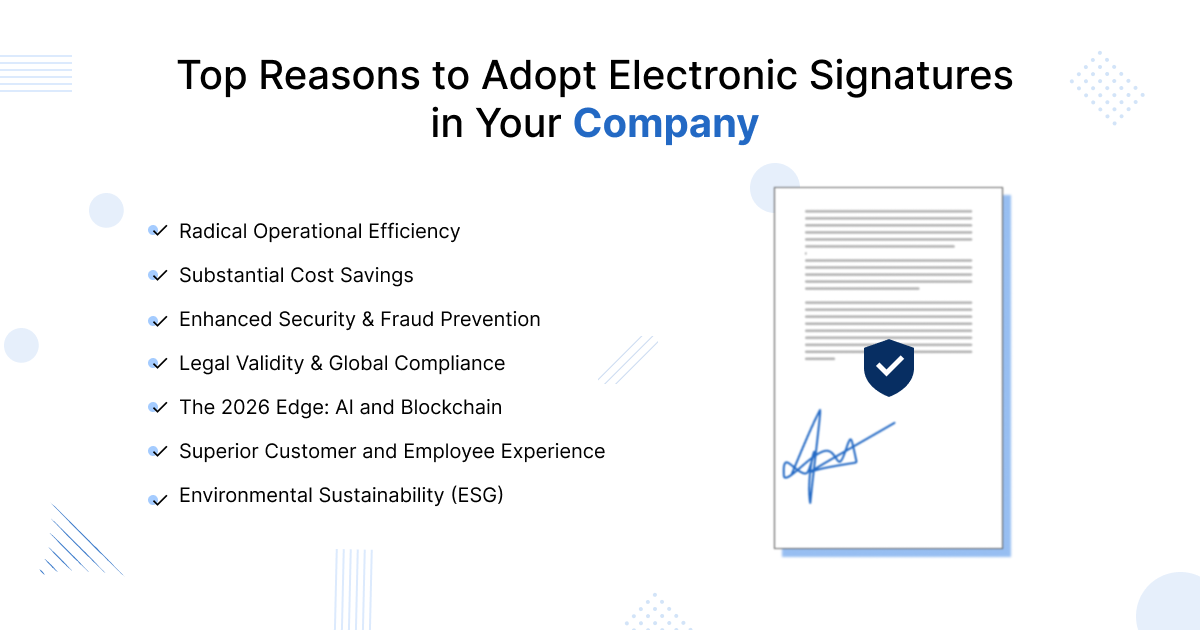
In the high-velocity business landscape of 2026, the concept of “time-to-revenue” has become the ultimate metric of success. For decades, the final hurdle in any deal—the signature—was ironically the slowest part of the process. We lived in a world of “print, sign, scan, and pray,” where critical agreements were at the mercy of malfunctioning office hardware or the physical speed of a courier truck.
However, as global markets have shifted toward a decentralized, mobile-first economy, the “wet ink” signature has transitioned from a tradition into a liability. The move toward electronic signatures is not merely a technical upgrade; it is a fundamental shift in how organizations establish trust.
Below, we explore the top reasons why your company should make the switch today.
Radical Operational Efficiency
The primary driver for electronic signature solutions is the compression of time. In 2026, business happens at the speed of thought, and waiting for a physical document is an unnecessary friction point.
Shortened Sales Cycles
Standard paper-based contracts often take an average of 5 to 7 days to complete, factoring in transit and internal routing. By contrast, 80% of documents sent via eSignature software are completed within 24 hours, and 44% are finished in under 15 minutes. This 400% increase in speed allows sales teams to hit quotas faster and reduces the “cooling off” period where buyers might change their minds.
Parallel vs. Sequential Workflows
Traditional signatures require a “relay race” approach: Person A signs, then Person B, then Person C. If Person B is on vacation, the process dies. Digital signature solutions enable parallel workflows where all parties receive the document simultaneously.
- Automated Reminders: Modern systems track who hasn’t signed and send gentle pings, removing the need for manual follow-ups by your staff.
- Error-Free Completion: One of the biggest time-wasters is a document returned with a missing signature or date. Electronic forms use “mandatory fields” that prevent a user from clicking “Finish” until every requirement is met.
The ROI Mathematics: Substantial Cost Savings
When calculating the cost of a signature, many leaders look only at the price of the software subscription. However, the true cost of a wet signature is hidden across several departmental budgets.
Direct vs. Indirect Cost
A deep-dive analysis reveals that companies save an average of $36 per agreement when moving to a paperless workflow automation model.
| Cost Category | Traditional “Wet” Signature | eSignature Solution |
| Consumables | Paper, Ink, Toner Envelopes | $0.00 |
| Logistics | Couriers, (FedEx/DHL), Postage | $0.00 |
| Labor | 1-2 hours of admin (filing, Scanning) | 5–10 minutes |
| Storage | Physical Cabinets, off-site warehouses | Secure Cloud (included) |
Reclaiming Labor Hours
Consider an HR department that processes 500 new hires a year. If each onboarding packet takes 2 hours to manage manually, that’s 1,000 hours of labor. At a modest $30/hour, that is $30,000 in lost productivity annually for a single department. Electronic signatures for business reclaim this time, allowing your team to focus on talent retention rather than paper shuffling.
Enhanced Security & Fraud Prevention
A common misconception in the early 2020s was that a digital signature was less secure than ink. In 2026, we know the opposite is true. An ink signature can be forged with a steady hand; a digital signature is protected by complex mathematics.
The Cryptographic Seal
When you use a digital signature solution, the document is “hashed.” This creates a unique digital fingerprint. If a single character is changed after the signature is applied, the hash will no longer match, and the software will immediately flag the document as “Tampered.”
The Audit Trail (Chain of Custody)
Every interaction with the document is logged in a court-admissible audit trail. This includes:
- Signer Identity: Verified via email, SMS Multi-Factor Authentication (MFA), or 2026-standard biometric “liveness” checks.
- IP Addresses: Recording exactly where the document was signed.
- Time Stamps: Down to the millisecond.
Don’t let your sales cycle stall in 2026.
While your competitors are waiting for couriers, you could be closing deals in minutes. Get the eSignature software built for the modern, high-velocity enterprise.
Legal Validity & Global Compliance
The legal framework for online contract signing is now more robust than ever. In the United States, the ESIGN Act and UETA provide the foundation, while in the European Union, the eIDAS regulation ensures cross-border validity.
- Admissibility in Court
Because of the detailed audit trail mentioned above, electronic signatures are often easier to defend in court than wet signatures. You don’t need a handwriting expert; you have a cryptographically signed log provided by a neutral third-party vendor.
Key 2026 Trend: Many jurisdictions now require Qualified Electronic Signatures (QES) for high-stakes transactions (like real estate or government tenders), which involve face-to-face identity verification via video call before a digital certificate is issued.
The 2026 Edge: AI and Blockchain
The current generation of eSignature software is far more than a “signing box.” It is integrated with the latest in AI and Decentralized Ledger Technology (DLT).
- AI-Powered Contract Analysis: AI can now scan your incoming signed documents to flag high-risk clauses or non-standard terms automatically, saving your legal team hours of review.
- Blockchain for Immutability: Some premium electronic signature solutions now anchor the document hash to a public or private blockchain. This ensures that the record of the signature exists forever, independent of the vendor’s servers.
Stop printing. Start growing.
Switch to the world’s most trusted electronic signatures for business.
Superior Customer and Employee Experience
In a competitive market, friction is a deal-killer. Whether it’s a customer or a new employee, the ease of secure document approval defines your brand.
Customer Experience (CX)
Forcing a customer to find a printer and scanner is an “exit ramp” for your deal. Offering online contract signing that works perfectly on a smartphone while the customer is commuting or at lunch is a powerful competitive advantage.
Employee Experience (EX)
High-performing employees hate “administrative debt.” By providing tools that automate the mundane, you boost morale and retention. Nobody wants to be the “person who scans the contracts” in 2026.
Environmental Sustainability (ESG)
Sustainability is no longer just a PR move; it is a reporting requirement for many 2026 enterprises.
- Resource Conservation: The average office worker uses 10,000 sheets of paper per year.
- Carbon Footprint: Eliminating the need for couriers and physical transport significantly lowers your Scope 3 emissions. Transitioning to a
- paperless workflow automation strategy is the “low-hanging fruit” for any Corporate Social Responsibility (CSR) goal.
Also Read: 7 eSignature Features Every HR Team Needs for Secure Hiring
Conclusion: Securing Your Place in the Future
As we have explored, the transition to digital signature solutions is far more than an environmental gesture or a quest for convenience. It is a comprehensive strategy for resilience. In the volatile markets of 2026, the companies that thrive are those that can pivot quickly, secure their intellectual property instantly, and provide a seamless experience for their stakeholders.
The risks of remaining in a paper-based or hybrid-manual system are mounting. Beyond the obvious costs of materials and labor, the legal and security vulnerabilities of physical documents are becoming impossible to ignore. In a world of sophisticated cyber threats and rapid-fire litigation, the “digital footprint” provided by modern software offers a level of protection that a piece of paper in a folder simply cannot replicate.
The future of business is paperless, encrypted, and instantaneous. By embracing electronic signatures today, you aren’t just solving a documentation problem—you are building a faster, more secure, and more sustainable foundation for everything your company will achieve in the decade to come.