


 Jan 16,2026
 By docstrail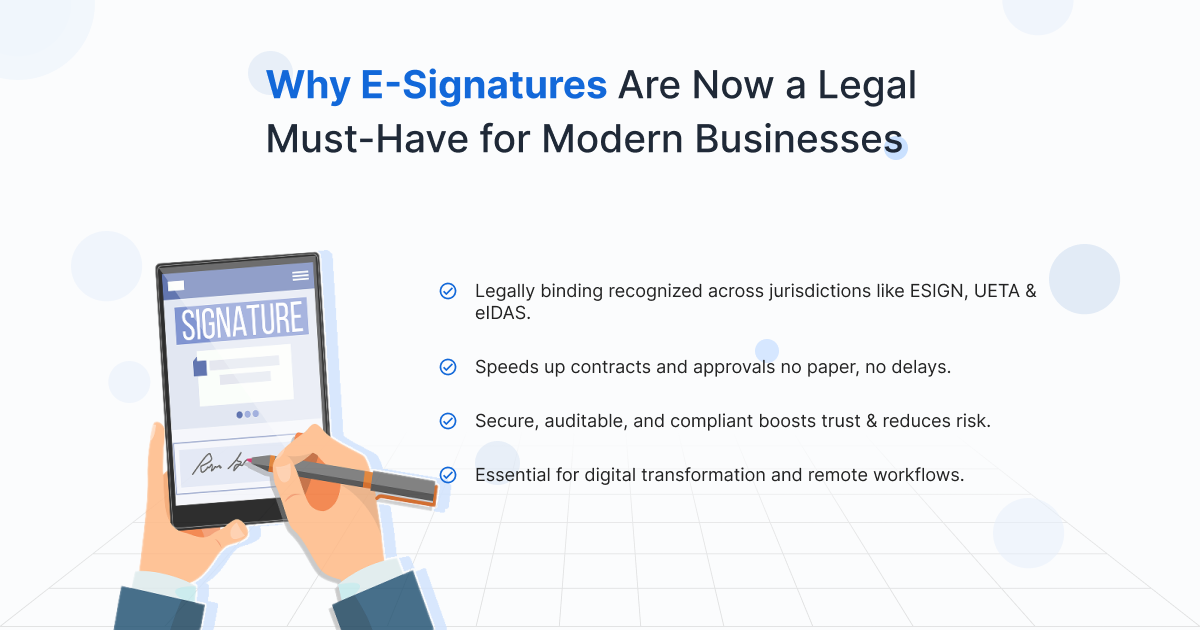
As of late 2025, the business world has moved past the “digital transition” phase. We are now in the era of Digital-First Compliance. What was once a convenience—the ability to sign a document on a smartphone—has evolved into a critical component of corporate Risk Management.
Whether you are a startup founder or a legal counsel for a multinational, understanding why E-Signatures are no longer optional is vital for your survival in the modern economy. This guide explores the legal, technical, and strategic reasons why Digital Signature Solutions are the new standard for Electronic Contract Signing.
The 2025 Legal Landscape: Beyond Paper and Ink
The legal validity of electronic signatures is no longer a debate; it is a global mandate. In 2025, three primary frameworks dictate the rules of the game:
1) The U.S. Framework: ESIGN and UETA
In the United States, the ESIGN Act (Federal) and UETA (State-level) remain the bedrock. They establish a simple but powerful principle: a contract or signature cannot be denied legal effect solely because it is in electronic form. However, by late 2025, courts have become stricter regarding the “Intent to Sign” and “Consent to Do Business Electronically.” Simply using a generic Online Signature Maker to doodle a name is often insufficient for high-stakes litigation if it lacks a robust back-end audit trail.
2) The EU Revolution: eIDAS 2.0
The European Union’s eIDAS 2.0 regulation, which reached a major implementation milestone in late 2024, has fundamentally changed how we view identity. The introduction of the European Digital Identity (EUDI) Wallet allows citizens to share verified identity attributes and execute Secure E-Signing across borders with “Qualified” status.
3) Global Harmonization
From Singapore’s Electronic Transactions Act to India’s updated IT Act provisions, the message is clear: businesses must prioritize Secure Digital Signatures that offer non-repudiation—meaning the signer cannot later claim they didn’t sign it.
4) Ready to Move Beyond Paper?
Streamline your workflows and close deals 80% faster with our Secure E-Signing platform. Join over 10,000 businesses that trust us for their Electronic Contract Signing needs.
[Start Your Free 14-Day Trial]
Why E-Signatures Are Legally Superior to “Wet” Ink
It is a common misconception that a physical signature is “safer” than a digital one. In reality, a paper document is a static object that can be easily forged, backdated, or altered. E-Signatures, however, are dynamic data sets.
The Power of the Audit Trail
Every time a document is signed via professional Digital Signature Solutions, a comprehensive audit log is generated. This log typically includes:
- IP Addresses: Where the signer was located.
- Timestamps: Exactly when the document was opened, viewed, and signed.
- Device Metadata: The hardware and browser used.
- Authentication Method: Whether the person verified their identity via email, SMS, or biometrics.
Cryptographic Integrity
Modern e-signing platforms use advanced cryptography to “seal” the document. When you sign, the software creates a unique hash—a digital fingerprint—of the document. In technical terms, this often involves a hashing algorithm like SHA-256.
H(message) → 256-bit hash
If even a single comma is changed in the contract after the signature is applied, the hash value will no longer match, and the Secure E-Signing platform will immediately flag the document as “Tampered” or “Invalid.” This level of Data Security is impossible to achieve with paper.
The Assurance Ladder: Choosing Your Signature Level
Not all e-signatures are created equal. In 2025, businesses must match the “assurance level” to the risk of the transaction.
Level 1: Simple Electronic Signature (SES)
This is the most common form, often used in Online Signature Makers. It’s perfect for internal approvals, low-value purchase orders, and standard NDAs.
- Risk Profile: Low.
- Legal Weight: Admissible, but may require extra evidence in court.
Level 2: Advanced Electronic Signature (AES)
An AES requires a higher level of identity verification. It is uniquely linked to the signer and created using data that the signer can use under their sole control.
- Risk Profile: Medium to High.
- Use Case: B2B contracts, employment offers, and mid-market sales.
Level 3: Qualified Electronic Signature (QES)
This is the gold standard of Secure Digital Signatures. It requires a face-to-face (or high-level remote) identity check by a Trust Service Provider. In many jurisdictions, a QES is the only legal equivalent to a handwritten signature for deeds, wills, and government filings.
- Risk Profile: Highest.
- Legal Weight: Presumed authentic in court; the burden of proof shifts to the person contesting the signature.
Industry-Specific Mandates: A Necessity, Not a Choice
In 2025, Electronic Contract Signing has moved from a “efficiency hack” to a regulatory requirement in several sectors:
1) Finance and Banking
With the rise of “Deepfake” fraud, banks now require Digital Signature Solutions that integrate with KYC (Know Your Customer) protocols. Failing to use a secure, authenticated signature can result in multi-million dollar fines for AML (Anti-Money Laundering) non-compliance.
2) Healthcare (HIPAA & GDPR)
Patient consent forms and telehealth agreements must be handled through encrypted channels. In the U.S., e-signatures must meet HIPAA’s technical safeguard standards to ensure that sensitive health data is never compromised during the signing process.
3) Real Estate and Legal Services
The adoption of Remote Online Notarization (RON) has made it possible to close a mortgage from a different continent. However, these transactions require the highest tier of Secure E-Signing to prevent title fraud—a growing threat in 2025.
Navigating Complex Global Compliance?
From Secure Digital Signatures to cross-border QES requirements, our experts are here to help you build a bulletproof digital infrastructure. Schedule a 15-minute consultation to audit your current Digital Signature Solutions.
Risk Management in the Age of AI
As we move through 2025, the biggest threat to contract integrity isn’t a missing pen—it’s AI-assisted forgery. Cybercriminals are now using generative AI to mimic handwriting and create synthetic identities.
To combat this, modern Digital Signature Solutions have integrated their own AI defenses:
- Behavioral Biometrics: Analyzing how a person signs (stroke speed, pressure, and angle) to ensure it’s a human, not a bot.
- Anomaly Detection: Flagging if a “signer” in New York is using a VPN from a high-risk region to access a million-dollar contract.
- Liveness Detection: Requiring a brief video “blink test” or selfie during the signing process for high-stakes deals.
By moving away from basic Online Signature Makers and toward enterprise-grade platforms, companies can effectively bake Risk Management into their daily workflows.
Implementation Checklist: Making the Switch
If your business is still relying on “Print, Sign, Scan,” or using insecure, unverified PDF tools, here is how to upgrade your Data Security posture today:
- Audit Your Transactions: Identify which contracts are high-risk (Qualified) and which are low-risk (Simple).
- Verify Compliance Certifications: Ensure your provider is SOC 2 Type II, ISO 27001, and HIPAA/GDPR compliant.
- Enable Multi-Factor Authentication (MFA): Never send a contract that can be signed with a single click from an unverified email.
- Integrate with Your Tech Stack: Look for solutions that plug directly into your CRM (Salesforce, HubSpot) or ERP, ensuring the Electronic Contract Signing process is seamless and the data is automatically synced.
- Train Your Teams: Ensure your sales and HR teams understand the difference between a “doodle” and a legally binding Secure Digital Signature.
Conclusion: The Cost of Inaction
In the legal environment of 2025, “we’ve always done it this way” is a dangerous defense. The transition to Secure E-Signing isn’t just about saving paper or moving faster—it’s about building a legally “bulletproof” foundation for your business.
A single contested contract can cost a company hundreds of thousands in legal fees. By contrast, adopting robust Digital Signature Solutions provides you with an immutable, timestamped, and cryptographically sealed record of every agreement your company makes.
Is your current signing process ready for a courtroom?