


 Jan 16,2026
 By docstrail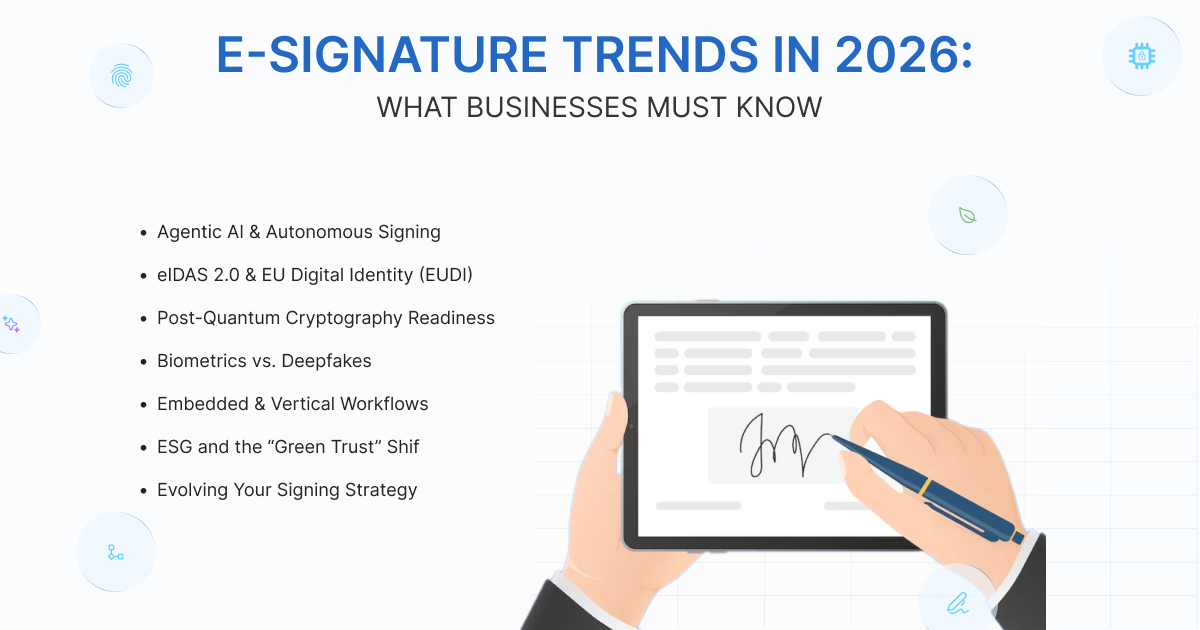
The year 2026 marks a watershed moment in the history of digital commerce. We have officially moved past the era where a digital signature was merely a “feature” of a document management system. Today, E-Signature Trends have evolved into something far more foundational: Programmable Trust. In this new landscape, the act of signing is no longer the final step in a static workflow; it is the ignition switch for a complex, automated, and hyper-secure ecosystem of digital agreements.
For years, businesses viewed E-Signature Software as a way to “go paperless.” However, as we navigate 2026, the focus has shifted from replacing paper to redefining identity. With the global digital signature market projected to grow at a staggering CAGR of over 30%, reaching nearly $20 billion this year, the technology has become the bedrock of the global economy. This growth is driven by a convergence of three massive forces: the maturity of Agentic AI, the legal mandate of the European Digital Identity (EUDI) Wallet, and the urgent necessity of Post-Quantum Cryptography.
In this comprehensive guide, we will explore the critical Digital Signature Solutions that are redefining the “signature” and what your organization must do to stay compliant, secure, and competitive in the year 2026.
- Agentic AI: The Rise of the Autonomous Signer
The most disruptive shift in E-Signature Software this year is the transition from “Assisted AI” to “Agentic AI.” In the past, AI helped us find where to sign. In 2026, AI Agents are authorized to sign on our behalf.
From Prompts to Actions
Unlike traditional Digital Signing Technology, which requires a human to review and click every field, Agentic AI uses goal-oriented reasoning. For high-volume, low-risk agreements—such as standard vendor NDAs or internal logistics forms—businesses are deploying autonomous agents that:
- Audit for Compliance: Scan the document against the company’s “Legal Playbook.”
- Negotiate in Real-Time: Flag deviations in liability clauses and suggest pre-approved alternatives.
- Execute the Signature: Sign the document once all internal guardrails are met.
Predictive Field Mapping 2.0
Modern Online Signature Makers have replaced static templates with “Intent-Aware Mapping.” AI now understands the semantic structure of a 50-page master service agreement, automatically identifying where a witness is needed versus where a primary signatory must provide a digital seal, reducing manual preparation time by nearly 85%.
Start Signing Securely in Seconds.
Looking for a modern Online Signature Maker that scales with your business? Start your free trial today and discover why thousands of businesses trust us for their Secure E-Signing needs.
2. eIDAS 2.0 & The European Digital Identity Wallet (EUDI)
If your business operates globally, 2026 is the year of the EUDI Wallet. Under the eIDAS 2.0 regulation, every EU member state is now required to provide a mobile-based Digital Identity Wallet to its citizens.
The End of “Identity Silos”
Previously, Digital Contract Signing required users to upload a photo of their passport for every new platform. In 2026, the E-Signature Future is built on Reusable Credentials. Users simply tap their phone, and their government-verified identity is cryptographically linked to the signature.
Selective Disclosure & Zero-Knowledge Proofs (ZKP)
A key trend in Secure E-Signing is the “Privacy-First” approach. Using the EUDI wallet, a signer can prove they are a licensed architect or over 18 without revealing their full name or home address. This is achieved through Zero-Knowledge Proofs, where the signature verifies an attribute rather than exposing raw identity data.
| Feature | Old E-signature (Pre-2025) | 2026 EUDI-Integrated Signature |
| Verification | Manual ID upload/selfie | One-tap cryptographic handshake |
| Data Privacy | Full ID data shred & stored | Selective disclosure (Attributes only) |
| Legal Weight | Variable/Jurisdictional | Uniform “Qualified” status across EU |
| User Friction | High (5-10 minutes) | Instant (<2 seconds) |
3. Post-Quantum Cryptography (PQC) Transition
As quantum computing moves closer to practical reality, the math protecting our digital signatures is being rewritten. In 2026, Secure E-Signing means migrating to Quantum-Resistant Algorithms.
The “NIST-3” Standards in Production
By 2026, production-grade Digital Signature Solutions have fully integrated the standards finalized by NIST. The primary algorithms you will see in your software’s technical specs include:
- ML-DSA (Dilithium): The new gold standard for general-purpose digital signatures.
- SLH-DSA (SPHINCS+): A stateless, hash-based fallback for high-security environments.
- ML-KEM (Kyber): Used for the secure key exchange that precedes the signing process.
Why It Matters Now
Cyber-adversaries are currently using “Harvest Now, Decrypt Later” (HNDL) tactics—stealing encrypted contracts today to crack them with a quantum computer in five years. Leading E-Signature Software providers now offer “Hybrid Schemes” that sign documents with both classical (RSA/ECDSA) and quantum-safe math simultaneously, ensuring longevity for contracts that must last 20+ years.
4. Multi-Modal Biometrics vs. Generative Deepfakes
The “Crisis of Trust” is real. With generative AI able to mimic voices and faces with terrifying accuracy, a simple video “liveness check” is no longer enough for high-value Digital Contract Signing.
Liveness Detection 2.0
In 2026, Digital Signing Technology uses multi-modal biometrics. Instead of just looking at a camera, the user must perform “Active Challenges,” such as:
- Eye-Tracking: Following a randomized light pattern on the screen.
- Behavioral Signals: Analyzing the unique cadence of how a user types their name or moves their mouse.
- Device Telemetry: Verifying the physical location and hardware health of the device used to sign.
Proof of Presence
The goal is no longer just “Who signed?” but “Was a human present?”. By integrating biometric signals directly into the signature’s metadata, businesses can prevent “authorized push payment” fraud and deepfake impersonation.
Experience the Future of Digital Contract Signing.
Ready to move beyond basic PDFs? See how our AI-powered E-Signature Software can automate your workflows and provide a seamless, embedded experience for your clients. Join the leaders in E-Signature Trends and transform your business today.
5. Hyper-Verticalized & Embedded Signature Workflows
We are witnessing the death of the standalone “signing portal.” In 2026, the best Online Signature Maker is the one you never actually see.
Embedded “Invisible” Signing
Businesses are increasingly moving away from third-party websites and embedding the signature experience directly into their own mobile apps and CRMs via APIs. This creates a white-labeled, seamless journey where the brand remains front and center.
Vertical Industry Use Cases:
- Healthcare: E-signatures are now natively integrated with Electronic Health Records (EHR), allowing patients to sign consent forms that automatically update their clinical chart in real-time.
- Real Estate: Digital signatures now trigger “Smart Escrow.” Once the final signature is verified, the funds are automatically released via blockchain-based smart contracts.
- Human Resources: Onboarding documents are no longer static PDFs; they are “Live Documents” that adjust their questions based on the signer’s previous answers, all while maintaining a legal audit trail.
6. ESG & The “Green Trust” Mandate
Sustainability is no longer a “nice-to-have.” In 2026, global regulations like the CSRD (Corporate Sustainability Reporting Directive) require businesses to quantify their environmental impact.
The Carbon Math of a Signature
Top-tier E-Signature Trends include built-in environmental reporting. Modern platforms provide a real-time “Sustainability Dashboard” that calculates:
- Trees Saved: Based on the weight of paper avoided.
- $CO_2$ Reduction: From the elimination of physical mail and courier transport.
- Water Usage: Reduced by bypassing the paper manufacturing process.
By 2026, many Digital Signature Solutions are marketed as “Carbon Neutral,” meaning the energy used to power the cloud servers for your signature is fully offset by renewable energy credits.
7. Strategic Checklist: How to Evolve Your Signing Strategy
To remain competitive in the E-Signature Future, businesses must audit their current processes against these 2026 standards:
- Review API Capabilities: Is your signature tool flexible enough to be embedded into your customer-facing apps?
- Test for PQC-Readiness: Ask your provider for their roadmap on Post-Quantum Cryptography migration.
- Verify EUDI Compatibility: If you have European customers, can your onboarding flow accept a Digital Identity Wallet?
- Define AI Guardrails: Establish a legal policy for which contracts can be signed by “Autonomous Agents” versus which require a “Human-in-the-Loop.”
- Consolidate Tools: Moving from five different Online Signature Makers to one unified platform reduces security vulnerabilities and lowers costs.
Also Read: Why E-Signatures Are Now a Legal Must-Have for Modern Businesses
Conclusion: Trust as a Competitive Edge
In 2026, the winner is not the company that signs the most documents—it’s the company that builds the most Verifiable Trust. By embracing Agentic AI, quantum-resistant security, and the revolution of Digital Identity Wallets, you aren’t just modernizing your paperwork; you are future-proofing your business.
The era of the “simple” e-signature is over. The era of the Identity-Backed, AI-Optimized Agreement has begun. If your business hasn’t updated its Digital Signature Solutions in the last 24 months, you are likely operating with yesterday’s security for tomorrow’s threats.